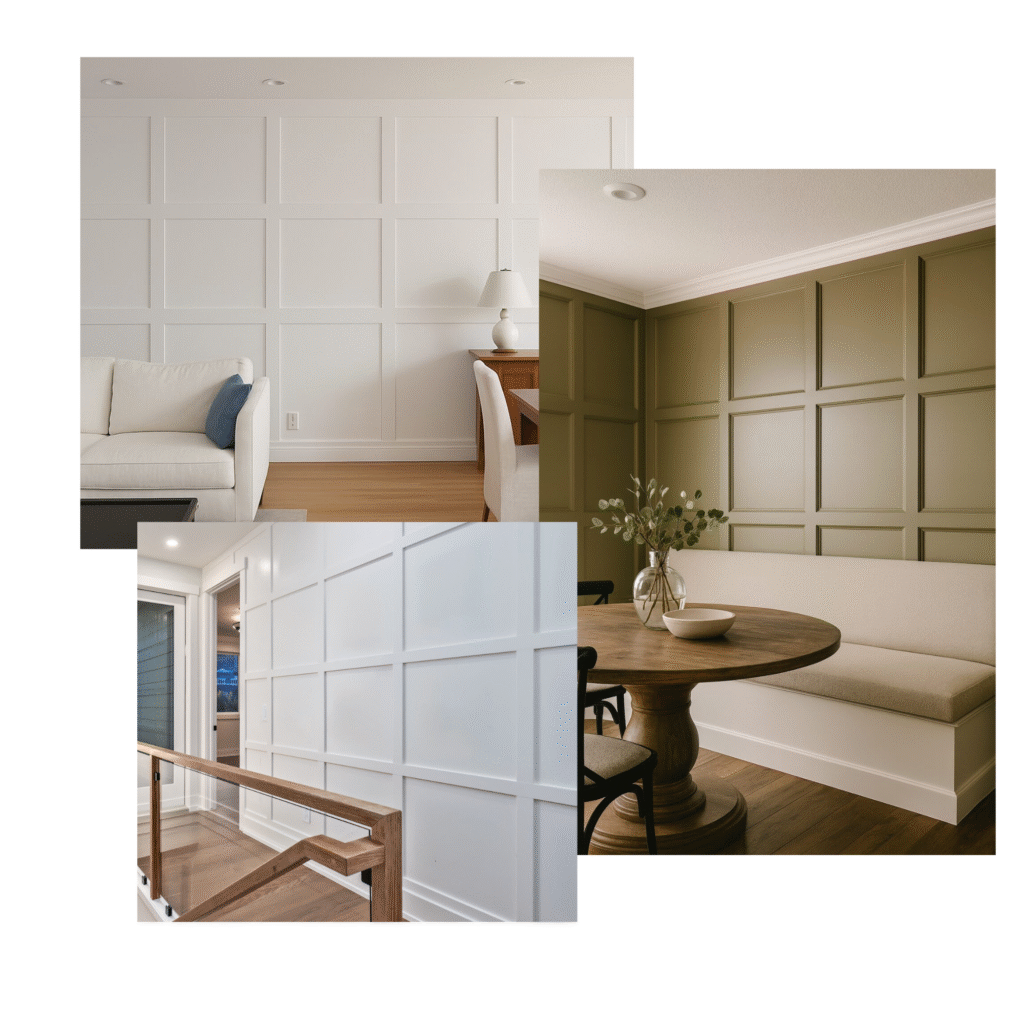
If you’ve searched “carpentry calgary” and landed here, you’re probably trying to figure out whether what you need is actually a finish carpenter — or some other trade entirely. Good question. There’s real confusion out there about what finish carpentry covers, and it costs homeowners time when they call the wrong person.
This post breaks down what finish carpenters do, why Calgary homeowners specifically tend to hire them, and how to tell whether you’re looking at a craftsman or someone who just owns a miter saw.
What Does a Finish Carpenter Actually Do?
Finish carpentry is the work that happens after the walls are up, the drywall is taped, and the rough trades are done. It’s everything that makes a house look like a home instead of a construction site.
That includes:
- Accent walls — shiplap, slat walls, board-and-batten, geometric paneling
- Wainscoting — raised panel, flat panel, beadboard
- Crown molding — single-piece or built-up profiles at ceiling transitions
- Coffered ceilings — grid-patterned beam structures that add depth and formality
- Built-ins — bookcases, entertainment units, mudroom lockers, window seats
- Trim work — door casings, window casings, baseboards, chair rail
- Staircase features — newel posts, balusters, skirt boards, feature walls alongside stairs
None of this is structural. A finish carpenter isn’t framing walls or building decks. The work is decorative and functional at the same time — and the tolerances are tight. A framing crew works to 1/4-inch. Finish carpenters work to 1/16th or less. That gap matters when you’re fitting crown molding into a corner that isn’t quite 90 degrees, which in Calgary homes, is basically every corner.
What finish carpentry is not: general contracting, cabinet installation (that’s usually a separate trade), or drywall. If someone is offering all of those under one banner, ask questions.
Why Calgary Homeowners Call a Finish Carpenter
There are three situations where finish carpentry makes the most sense.
New builds with builder-grade finishes
Production builders in communities like McKenzie Towne or Evanston deliver homes that are technically complete but visually flat. The baseboards are thin. The casings are stock profile. There’s no character. Many homeowners move in and immediately start planning how to make it feel like theirs — and finish carpentry is usually the first call.
Renovations targeting specific rooms
Not every renovation needs to gut a room. We get calls from homeowners in Bridgeland and Aspen who want to upgrade a primary bedroom, add a feature wall in the living room, or transform an ordinary dining room with wainscoting and crown. You don’t need to move walls to make a room feel completely different.
Homes being prepared for sale
Finish work is one of the highest-return investments before listing. Buyers notice trim quality, built-ins, and ceiling details — even if they can’t articulate why one house feels more finished than another. It’s not accidental. Those details are the product of deliberate carpentry.
In my experience, the projects with the clearest ROI are built-ins in main living areas and wainscoting in dining rooms. They photograph well, they hold up to inspection, and they make a home feel custom without requiring a full renovation.
What Separates a Good Finish Carpenter from an Average One
This is where it gets practical. Four things separate skilled finish carpenters from people who can technically do the work:
Precision at scale
Anyone can cut a miter that looks good in isolation. The skill is doing it consistently across a full room — 40 linear feet of crown, inside corners, outside corners, vaulted transitions — and having every joint be tight. That requires sharp tooling, proper technique, and the patience to test-fit before fastening. We see a lot of “finished” work during consultations where the caulk is doing most of the structural work. That’s a sign of someone who rushed.
Working around other trades
Finish carpenters come in late in a project. Painters, electricians, HVAC — they’ve all left their mark on the space. A good finish carpenter sequences their work to avoid rework, protects surfaces that are already painted, and communicates with the GC or homeowner about what needs to happen before they arrive. Showing up before primer is done wastes everyone’s time and money.
Material knowledge for Calgary’s climate
This is underrated. Calgary is dry — really dry in winter, with humidity dropping below 20% in heated homes. Wood moves. MDF is stable dimensionally but doesn’t hold fasteners as well and can swell if there’s any moisture exposure. For anything going into a bathroom or laundry room, we use solid wood or PVC trim, not MDF. For painted built-ins in living areas, MDF panels work fine for large flat surfaces, but solid wood for the face frames and doors. Knowing when to use which material — and being honest about it with clients — is part of the job.
We’ve also seen engineered wood products fail in Calgary homes where the heating runs hard. When a client shows us a built-in that’s delaminating after three winters, it’s usually an engineered product that wasn’t the right call for that application.
A design eye, not just technical skill
The best finish carpenters can tell you what will and won’t look right before you commit. Profile scale relative to ceiling height. Wainscoting proportions. Whether a coffered ceiling will feel heavy or elegant in a given room. These aren’t opinions — they’re based on visual principles that experienced carpenters develop over hundreds of installs. If you’re getting a quote and the person can’t tell you why they’d make certain choices, that’s worth noting.
What to Expect Working With Calgary Custom Concepts
Here’s how our process works:
- Initial consultation: We visit the site, take measurements, and talk through your goals. No commitment at this stage — just information gathering.
- Quote: We provide a written scope with line items. You know exactly what’s included and what isn’t.
- Scheduling: Most residential projects book 2–4 weeks out. We’ll confirm a start date when you approve the quote.
- Install: Our crew works clean, protects finished surfaces, and doesn’t leave until the job is done right. Most accent wall installs take 1–2 days on site. Larger built-in projects or full-room packages run 3–5 days.
- Walkthrough: We walk the finished work with you before we leave. If something isn’t right, we fix it before the invoice is closed.
We serve Calgary and the surrounding area: Airdrie, Cochrane, Okotoks, and Chestermere. If you’re outside that radius, reach out anyway — we evaluate larger projects case by case.
Common Finish Carpentry Projects in Calgary
Here’s a quick look at the work we do most often:
Accent walls
Board-and-batten, shiplap, slat walls, geometric paneling — accent walls are the most-requested project we do. They transform a room in 1–2 days and work in living rooms, bedrooms, dining rooms, and home offices. A recent install in a Bridgeland home paired vertical slats with integrated lighting — completely changed the feel of the main floor.
Wainscoting
Raised panel, flat panel, or beadboard — wainscoting adds texture and formality to dining rooms, hallways, and primary bedrooms. We typically run it to 36–42 inches on standard 9-foot ceilings. The proportions matter more than most people realize.
Crown molding
Crown is one of the most technically demanding finish carpentry tasks — cutting compound miters, dealing with out-of-square corners, running transitions between rooms. When it’s done well, it’s invisible. When it’s done poorly, every gap shows. We don’t fill bad cuts with caulk.
Coffered ceilings
A coffered ceiling is a significant project — typically 3–5 days depending on room size and complexity — but the visual impact is hard to match. They work best in dining rooms, offices, and primary bedrooms with at least 9-foot ceilings.
Built-ins and shelving
Built-in bookcases, entertainment units, mudroom benches and lockers, window seats — these are projects where custom carpentry beats furniture every time. The fit is exact, the materials are your choice, and the result is permanent.
Staircase features
Feature walls alongside staircases, updated newel posts and balusters, skirt boards — staircases are high-visibility and often the most dated part of a home. A staircase refresh can completely change the entry experience.
Ready to Get Started?
If you’re not sure what your project needs, start with our residential quiz — it takes about 2 minutes and helps us understand your goals before we connect.
If you already know what you want, request an estimate directly: