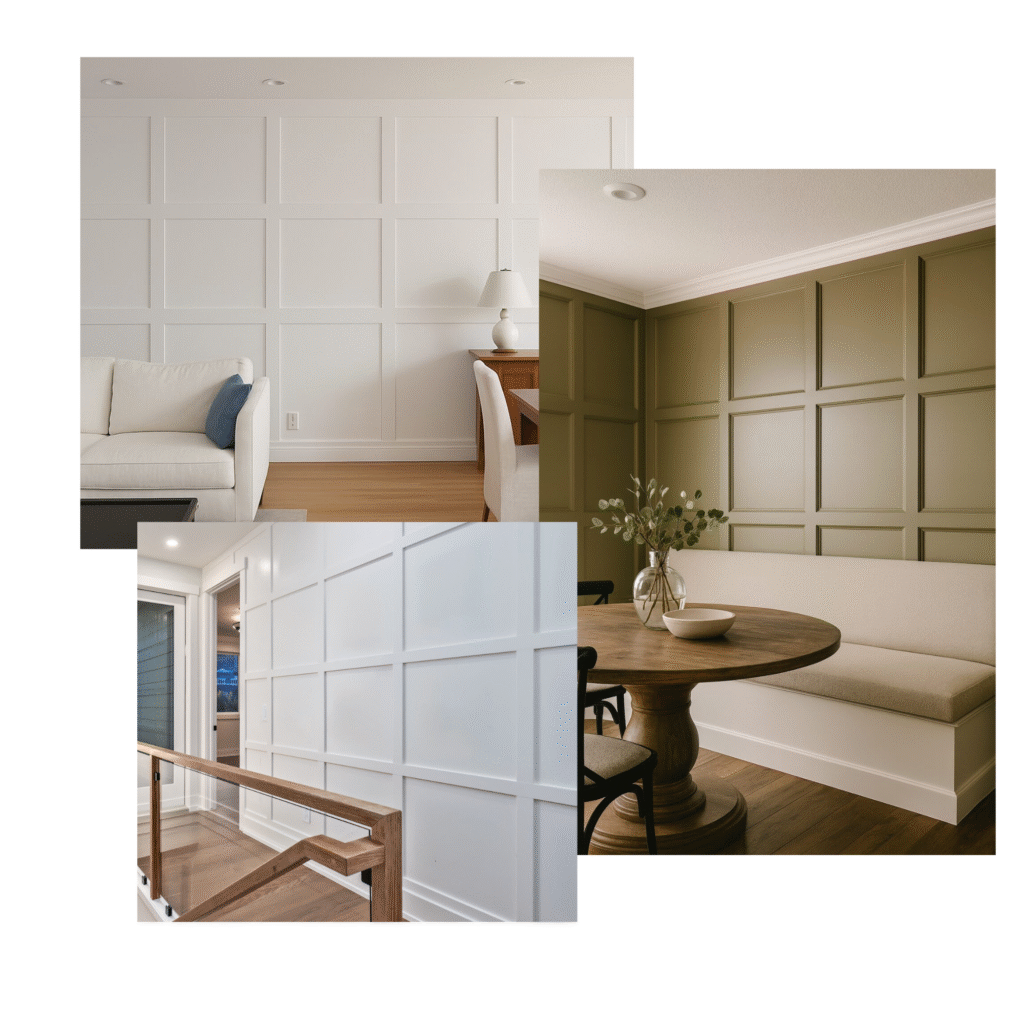
These three terms get used interchangeably online, but they are actually three different things — with different looks, different installation complexity, and different rooms they work best in. Here is how to tell them apart and figure out which one belongs in your space.
Wainscoting: The Classic Half-Wall Treatment
Wainscoting covers the lower portion of a wall — typically one-third to half the wall height — and caps off with a horizontal rail. Below the rail is the paneling (flat panels, raised panels, or beadboard), and above it is your regular painted or wallpapered wall.
Best in: Dining rooms, hallways, entryways, powder rooms. Anywhere you want to add formal structure and protect a high-traffic wall from scuffs and chair backs.
The look: Traditional, refined, architectural. Works well in both heritage homes and modern spaces when you use flat panels and clean lines instead of ornate profiles.
Consider it if: Your ceilings are 9 feet or higher and you want to add visual weight without paneling the whole wall. It draws the eye to the lower half and makes rooms feel grounded and complete.
Board and Batten: Vertical Lines, Modern Edge
Board and batten uses wide flat boards set against the wall with narrow vertical strips (battens) covering the seams. It can run half-wall like wainscoting, or go full-height for a more dramatic statement.
Best in: Bedrooms, living rooms, kids’ rooms, mudrooms. Great for adding texture to flat, boring walls without touching anything structural.
The look: Farmhouse, transitional, or clean-modern depending on your spacing and profile choice. Tight spacing reads more formal; wider spacing reads more casual and relaxed.
Consider it if: You want a project that’s impactful but relatively fast to install. Board and batten moves efficiently — it’s one of the more approachable feature wall types in terms of timeline.
Full Wall Paneling: Maximum Impact
Full wall paneling runs floor to ceiling and treats the entire wall as a design surface. This can be shiplap, large-format panels, vertical slats, or a custom millwork grid. It’s the most architectural option and the most involved to install well.
Best in: Living rooms, primary bedrooms, home offices, entryways where you want a true focal point.
The look: Anything from contemporary (thin slats, dark stain) to traditional (raised panel grids, painted white) depending on the profile and finish you choose.
Consider it if: The room has a wall that needs a purpose — a fireplace wall, a bed wall, a TV wall — and you want it to read as intentional architecture rather than a decorative afterthought.
The Short Version
- Wainscoting: Formal, half-wall, best for dining rooms and hallways
- Board and batten: Versatile, vertical, works at any height, faster to install
- Full wall paneling: Maximum impact, best for focal-point walls, more complex
Not sure which one fits your room? The project quiz takes two minutes and helps us give you a straight recommendation based on your actual space and goals.