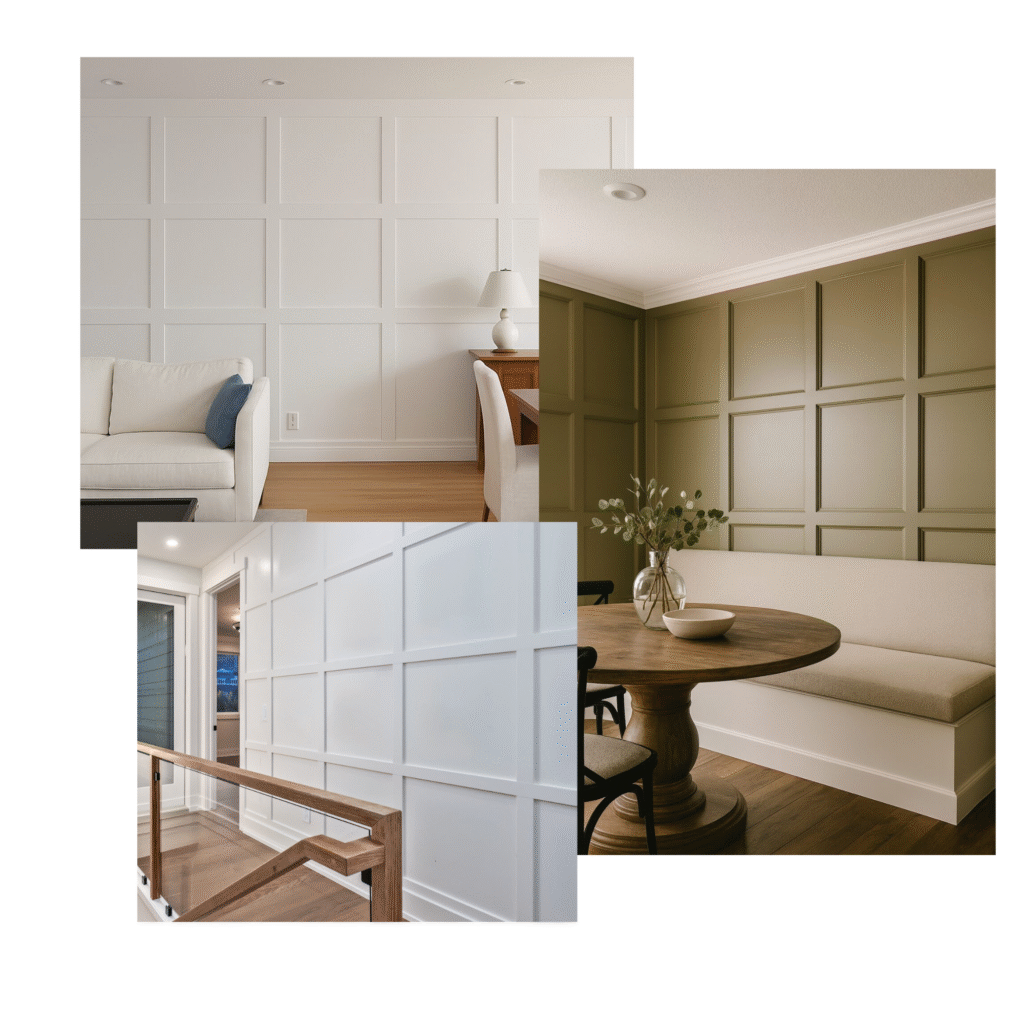
If you have lived in Calgary through a few winters, you have probably noticed your hardwood floors making new sounds or your interior doors sticking in summer. Wood moves with humidity — and Calgary’s climate gives it a lot of reason to move.
Understanding this isn’t just trivia. It directly affects how your trim, accent walls, and built-ins hold up over time, and what your carpenter should be doing before, during, and after installation.
What’s Actually Happening to Your Wood
Calgary has one of the driest climates of any major Canadian city. In winter, indoor relative humidity can drop to 15–25% — well below the 35–55% range that most wood products are manufactured and tested at. In summer, especially during storm season, it can spike above 60%.
Wood fibers absorb and release moisture from the air. As they do, the wood expands and contracts — mostly across the grain, not along it. This is called seasonal movement, and it’s completely normal. The problem is when it isn’t accounted for.
Common signs that wood movement wasn’t properly managed:
- Gaps opening at trim joints or paneling seams in January or February
- Cupping or bowing on wider boards
- Paint cracking along joints that weren’t properly primed or sealed
- Mouldings pulling away from walls at outside corners
What Good Carpenters Do Differently
The difference between trim that holds up and trim that gaps isn’t always the material — it’s the process.
Acclimation: Wood and MDF should sit in your home for at least 48–72 hours before installation. This lets the material reach equilibrium with your indoor humidity before it’s cut and fastened. Skip this step and the material moves after it’s already nailed in place.
Material selection: Narrower boards move less than wide ones. Stable species like poplar handle Calgary winters better than wide-grain hardwoods. MDF is more dimensionally stable than solid wood for painted applications — a real advantage in dry climates.
Fastening and joint design: Leaving appropriate expansion gaps in paneling, using adhesives alongside mechanical fasteners, and back-priming panels before installation all reduce the visible effects of seasonal movement.
Humidity management: Running a humidifier through winter — targeting 35–45% relative humidity — is one of the best things you can do for your trim, floors, and furniture. It also makes a noticeable difference in how your family breathes and sleeps during the dry months.
What to Expect Over Time
Even well-installed trim will show minor seasonal movement in Calgary. A hairline gap at a joint in February isn’t a sign of bad work — it’s physics. The gap should close again as humidity rises in spring.
If you’re seeing large gaps, consistent cupping, or paint cracking every winter, that’s worth addressing. The fix is usually caulk for painted trim, and a humidity conversation for anything stained or natural.
Planning a trim or accent wall project this year? Our quiz helps us understand your space — including your home’s current humidity situation — before we make any recommendations.