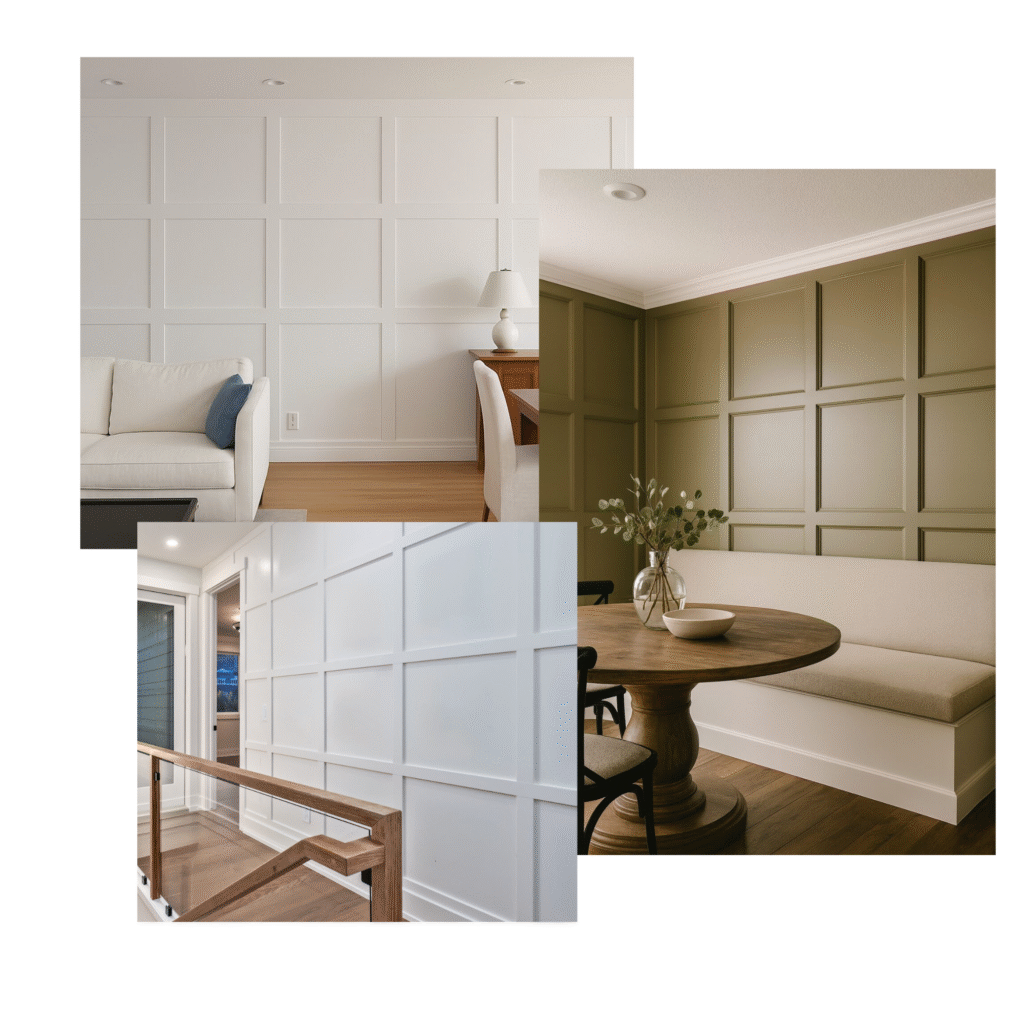
One of the most common questions homeowners ask before starting an accent wall project is: what should it actually be made of? The answer depends on your space, your finish goals, and — especially in Calgary — your home’s humidity levels throughout the year.
Here’s a practical breakdown of the three most common materials: MDF, solid wood, and engineered wood products.
MDF: The Workhorse for Painted Finishes
MDF (medium-density fiberboard) is the default choice for most painted accent walls, and for good reason. It’s dimensionally stable, takes paint beautifully, and has a smooth, consistent surface that solid wood can’t match for crisp, clean lines.
Best for: Board and batten, shiplap profiles, wainscoting panels, geometric feature walls — anything that’s getting painted.
Limitations: MDF doesn’t love moisture. It swells when wet and doesn’t perform well in bathrooms or unfinished basements without a proper moisture barrier. It’s also heavier than solid wood at the same thickness, which matters for large panels.
In Calgary’s dry climate, MDF actually performs well — low humidity means less swelling risk. That said, good installers still seal the edges and back-prime panels before installation to lock in stability.
Solid Wood: When You Want the Real Thing
Solid wood — pine, poplar, oak, maple — is the right choice when you want a natural grain, a stained finish, or a material that has warmth you can actually feel.
Best for: Shiplap in a bedroom or cabin aesthetic, stained wood feature walls, natural-look paneling, anything where the material itself is the design.
Limitations: Solid wood moves. It expands and contracts with humidity changes, and in Calgary’s seasonal swings — very dry winters, more humid summers — that movement is real. Species matter here: stable options like poplar and pine handle movement better than wider-grain hardwoods. Proper acclimation before installation is non-negotiable.
The upside is longevity and repairability. A solid wood wall can be sanded and refinished years down the road. MDF cannot.
Engineered Wood: The Practical Middle Ground
Engineered products — pre-primed MDF mouldings, finger-jointed pine, composite shiplap boards — sit between MDF and solid wood. They’re more dimensionally stable than solid wood, take paint better than raw pine, and are often more affordable for large-scale projects.
Best for: Trim work, profile mouldings, shiplap in painted applications, large feature walls where consistency across many boards matters.
Finger-jointed pine is a go-to material for painted trim. It’s stable, straight, and sands cleanly. Once painted, most people can’t tell the difference from solid pine.
The Short Answer
If it’s getting painted: MDF or finger-jointed pine. If you want to see the wood: solid lumber, properly acclimated. If you’re covering a large surface on a tighter budget: engineered products.
Still not sure what’s right for your project? Our quick quiz walks through your space and goals — it takes two minutes and gets us on the same page before any decisions are made.