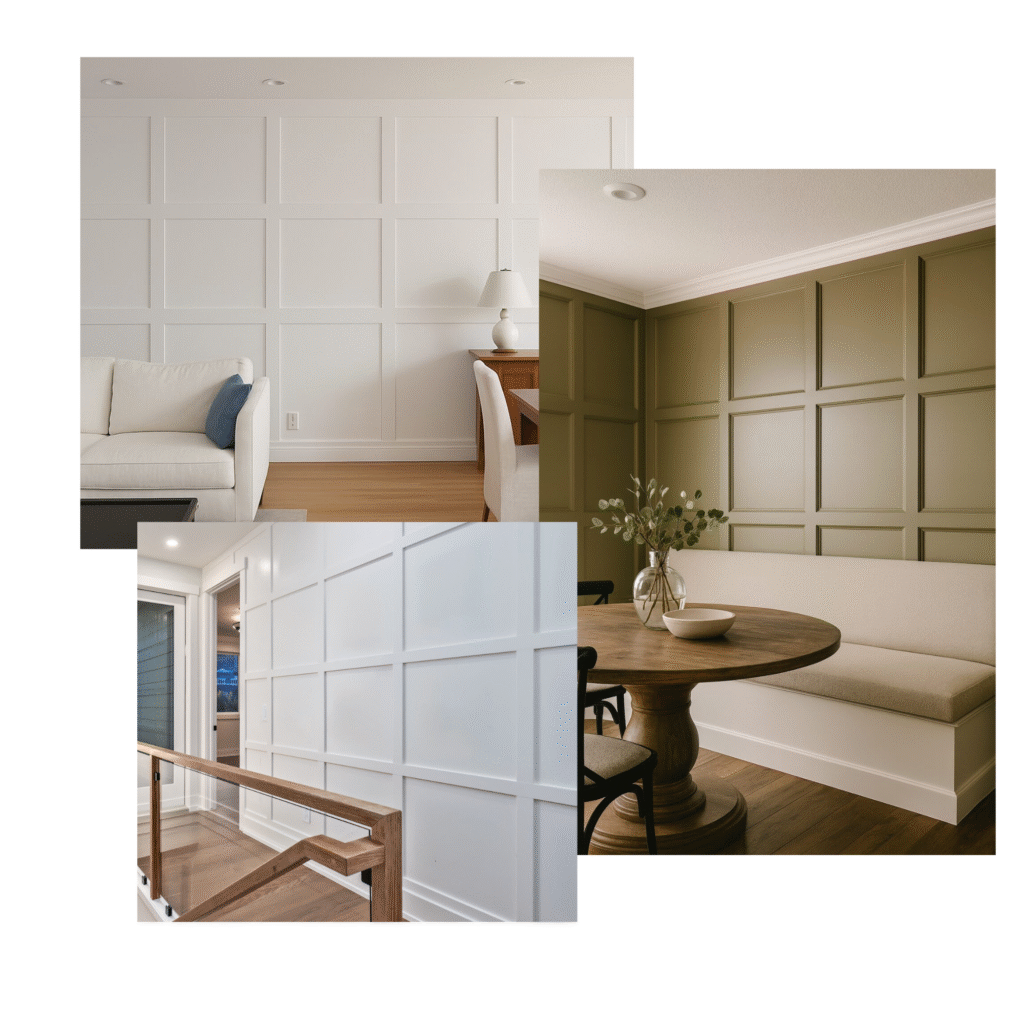
Why This Fear Comes Up
It’s one of the most common hesitations we hear: “I love the idea, but I’m worried it’ll make the room feel smaller.”
It’s a reasonable concern. Dark colors, bold textures, and strong visual elements can absolutely make a room feel heavy if they’re used without intention. But the fear is usually pointed at the wrong thing — it’s not the accent wall itself that causes that effect. It’s specific design choices within it.
Understanding the actual principles gives you a lot more confidence — and usually opens up more options, not fewer.
The Design Principle: It’s About Visual Weight, Not Square Footage
A few things actually govern how a wall treatment affects perceived space:
Color value (light vs. dark): Dark colors optically recede — a dark wall appears to push back from the viewer, which can actually make a room feel deeper. Light colors advance — a bright wall feels closer. This is counterintuitive for a lot of people. A dark feature wall opposite the entry point of a room often makes the room feel longer, not shorter.
Line direction: Vertical lines (like slat walls or tall board and batten) draw the eye upward, making a room feel taller. Horizontal lines (shiplap, horizontal paneling) draw the eye sideways, making rooms feel wider. Neither is inherently space-compressing — they just emphasize different dimensions.
Texture scale: Fine texture (narrow slats, small panel grids) reads as less heavy than coarse texture at the same wall size. This is why a slat wall can look airy despite being a strong visual element.
The surrounding context: A dark feature wall in a room with light furniture, pale flooring, and good lighting will read very differently than the same wall in a room with heavy dark furniture and no natural light. The accent wall doesn’t exist in isolation.
How CCC Addresses This Before Installation
This is exactly why we provide a design render before any work starts. A render lets you see the wall treatment in the context of your actual room — your ceiling height, your furniture, your flooring. It removes the guesswork and replaces it with a real visual.
In cases where clients are concerned about space, we’ll often mock up two or three options at different color values or profile scales so they can compare. The render conversation is where a lot of the anxiety about space gets resolved — because once you can see it, the concern usually either confirms or disappears.
Examples Where the Right Wall Makes a Room Feel Bigger
A few patterns we see repeatedly:
- A dark slat wall in a room with low ceilings: The vertical lines and the visual recession of the dark tone often make the ceiling feel higher than it is.
- Full-height board and batten in a narrow entryway: The vertical lines elongate the space dramatically. This is one of the most effective tricks in finish carpentry for small spaces.
- Shaker panel wainscoting in a small dining room: Adds architectural detail and weight to the lower half of the room, which grounds the space and makes the upper half feel more open by contrast.
In each case, the wall treatment didn’t shrink the room — it gave the room a sense of intention that it didn’t have before. Blank, flat walls without visual structure often make spaces feel more ambiguous and smaller-feeling than a well-executed wall treatment does.
Ready to see what a feature wall would actually look like in your space? Start with our 90-second quiz, or book a consultation and we’ll work through the options with you.